Saturday, May 30, 2015
Weekly Indicators for May 25 - 29 at XE.com
- by New Deal democrat
My Weekly Indicator post is up at XE.com.
The parttern that has existed since mid-February of awful industrial data and poor consumer spending, but good comparisons for everything else, is firmly intact.


Friday, May 29, 2015
Texas Flooding Picture
There have been a ton of pictures and videos showing the recent flooding in Texas. But this picture stands out as the best. First, a bit of background. Stevie Ray Vaughn's first album was called Texas Flood. It also contained a slow blues called "Texas Flood." Here is a picture of Stevie's statue in Austin either walking on water or rising about the Texas flood. Either way, it's just perfect.


BTW: I'm fine and unscathed.
Mixed news from leading indicators in Q1 GDP
- by New Deal democrat
I have a new post up at XE.com.
Corporate profits and gross domestic income, two leading indicators from GDP, were reported for Q1 for the first time this morning. The news is mixed.
Thursday, May 28, 2015
Analyzing the crosscurrents: a maturing expansion
- by New Deal democrat
At the moment the US economy doesn't seem to be flowing with any strong central current. I've been meaning to write an overview of these, and I suppose now is as good a time as any. No bunch of graphs or links here, just a sense of my overall view.
1. Without a big positive, the economy is being driven by smallball improvements.
The US has been for the last several generations, consumer-driven. Typically increased consumer spending has been funded by one or more of the following sources:
- increased real wages
- refinancing of existing debt at lower interest rates (thus freeing more cash flow)
- an increase in asset values, such as stocks (1982-2000) or houses (2001-2005)
When all of these sources of increased available cash have dried up, recessions have ensued. In the case of refinancing, that has tended to peter out about 3 years after the last new low in interest rates.
So where are we now? We are getting a slight bit of help from all sources:
- helped by the crash in gas prices, real wages have made fresh post-recession highs this year
- mortgage interest rates last made new lows near the end of 2012, so that bout of refinancing is still helping a little bit
- stock prices are at new all-time highs, fueling the wealth effect among the more affluent, while house prices have also appreciated to post-recession highs, meaning fewer homeowners are "underwater" although home equity withdrawal is probably dead for years to come.
The earliest all three of these could be negative is the end of this year. Unless mortgage interest rates make new lows, beginning in 2016 the expansion is on borrowed time.
2. Interest rates drive housing, and housing drives the economy
As readers of this blog well know, the building of new housing affects the economy a year or more out. That's because houses must be filled with furniture, appliances, and other improvements. Decks, gardens, and other landscaping are installed. This can take several years.
So in mid-2013, the "taper tantrum" caused a spike in interest rates. By early 2014, new housing completely stalled, in several months turning negative YoY. Since then mortgage rates fell by roughly 1%, and now housing has made new post-recession highs.
This means that the poor GDP in the first quarter and probably somewhat now can be ascribed to the poor housing market of early 2014. Over the next year, the improvement in housing should feed through to an improvement in the broader economy.
3. The winter did have an impact, but it is over
Yes, we have winter every year, but some are more severe than others. After 10 mild winters, in 2014 and 2015, the northeast and midwest had particularly nasty and cold winters. The data suffered. In particular, the awful winter probably accounts for the poor retail sales numbers in January and February (since recovered in March and April), and also the abysmal housing starts number in February (since completely recovered in April).
4. The west coast ports strike had an impact, but it's over
This is outsourced to Bill McBride a/k/a Calulated Risk. Port traffic on the West Coast has returned to normal.
5. The Oil patch has been kicked in the chops, but strength elsewhere has more than offset the downside in most regards
This is best shown in the state by state breakdown in weekly initial jobless claims. New 15 year lows in nationwide claims have been set, even as states like - especially - Texas have had big YoY increases. Meanwhile the Empire State and Philly Fed indexes show expansion, even as Kansas City and Dallas show sharp contraction.
At the same time, those Oil patch layoffs are probably responsible for the failure of retail sales to make new highs since November, as we know that those laid off cut back expnses sharply. At the same time, like in 1986 when oil prices collapsed, consumers at first saved the money, only spending it in full after the passage of an entire year.
6. On the US$, maybe it's time for the Obama Administration to wiegh in more publicly on Grexit
As I've pointed out in other posts, the US$ appreciated by about 16% on a trade-weighted basis between last summer and March. As a result, exports have taken a big hit, as shown in the weekly rail and steel statistics. At the moment, not only are Germany's beggar thy neighbor policies killing the Euro periphery, but that big slide of the Euro vs. the dollar has brought US growth to a complete standstill. That should remedy itself with a rebalancing of the currencies, but not with continuing brinksmanship in Europe over Grexit, and now Brexit and soon to be added Spexit.
So far the US has, prudently, regarded this as "a fire across the river" to use the Japanese maxim. But with US growth so seriously affected, it migh be time for a more public and/or coercive approach.
7. The Fed is really caught between Scylla and Charibis
The Fed seems bound and determined to raise rates. In practice, it is treating 2% core inflation as a ceiling rather than a target, having tolerated lower inflation for years, but announcing that it will be proactive against any breach to the upside.
When the Fed raises rates, what will happen to long rates? A significant increase will kill the housing market. A significant decrease will cause a yield curve inversion. The Fed has to hope that long rates remain in a narrow band of stability. I'm not holding my breath for the success of that strategy.
Bottom line:
- There are some transient negatives (Oil patch wekaness, the overly strong US$), but at least until the end of this year, the economy is underpinned by fundamental positives.
- After that, there are lots of ways for the economy to enter a cul-de-sac, most notably interest rate increases and/or an increase in gas prices while I don't see the economy rolling over yet, I do think the expansion is past its midpoint, and is maturing.
Tuesday, May 26, 2015
Monday, May 25, 2015
Memorial Day 2015
- by New Deal democrat
"The world will little note, nor long remember what we say here, but it can never forget what they did here."
- Abraham Lincoln, Gettysburg address
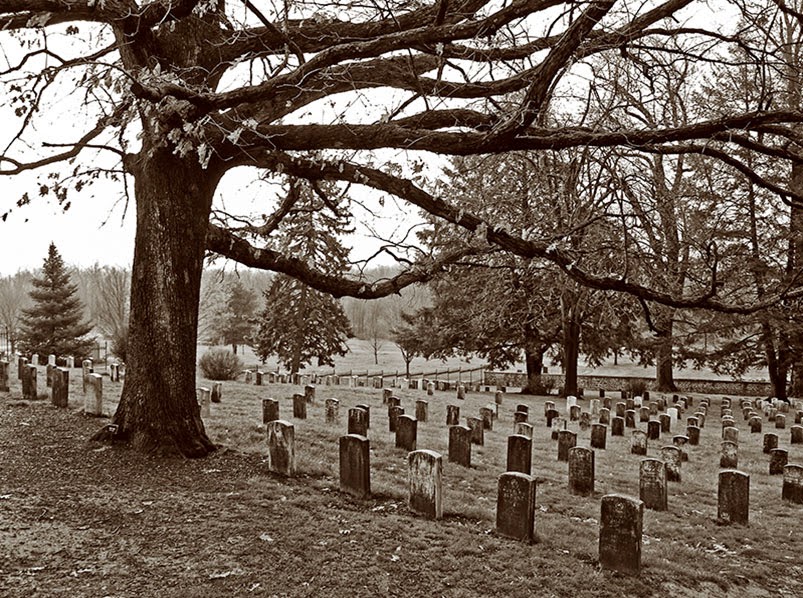
Gettysburg National Cemetery

Antietam National Cemetery

"We cannot dedicate - we cannot consecrate - we cannot hallow - this ground. The brave men, living and dead, who struggled here, have consecrated it, far above our poor power to add or detract." - Abraham Lincoln
Saturday, May 23, 2015
Weekly Indicators for May 18 - 22 at XE.com
- by New Deal democrat
My Weekly Indicator post is up at XE.com.
The bifurcation between the shallow industrial recession and the resilient domestic economy is, if anything, intensifying.
Friday, May 22, 2015
Wednesday, May 20, 2015
The most important positive data of the year
- by New Deal democrat
Yesterday's report that housing permits and housing starts both reached post-recession record highs in April was the most important data of the year to date.
Quite simply, it takes the possibility of recession off the table for the rest of this year. I expect employment and income to continue to grow, and real retail sales to make overcome the weakness they have exhibited since last November, and make new highs. This also suggests positive news as to wages in the coming months.
For the record, here is the graph of permits (blue) and starts (red) for the last 5 years:

As I pointed out 2 months ago when starts fell off a cliff, starts are much more volatile than permits. As permits also tend to lead starts by a month or two, they are the "go to" number of the two. I read some Doomish commentary by Mish yesterday, pointing out the volatility of the numbers as an excuse to ignore them. Funny, I didn't hear that caution two months ago when the data tanked. Hmmmmmm.....
And the 3 month rolling average of permits is also at a new post-recession high.
I have been pounding the table since the "taper tantrum" of 2 years ago that interest rates drive housing (subject to demographic trends). But if you don't believe me, how about this graph, which was published yesterday with the explanation "Here’s the inverse of the Fed funds rate versus housing starts:"

That was published by Paul Krugman yesterday, to the point that
houses last a long time and don’t become obsolete (the same is true to some extent for business structures, but in a more limited form). So Fed policy, by moving interest rates, normally exerts its effect mainly through housing.So, as I occasionally remind you, you've been reading the right blog.
And here is the close-up of the last few years showing the YoY change in housing permits (blue) vs. the inverse of mortgage rates (red):

While mortgage rates haven't made new lows (thus refinancing remains somnolent), they haven't retreated significantly off recent lows. I therefore expect improvement in the housing market to continue.
Now if the $US could back off its recent highs, the shallow recession in the industrial part of the economy should also go away.
Tuesday, May 19, 2015
Describing the shallow industrial recession
- by New Deal democrat
I have a new post up at XE.com, describing the shallow industrial recession since November, and why it is not now nor do I expect it to become an economy-wide recession.
Monday, May 18, 2015
John "Dan Rather of the Right" Hinderaker Once Again Shows His Remarkable Lack of Credibility
From Powerline:
Building and maintaining roads, bridges, sewers and so on is a core function of government, second only to national security at the federal level, and law enforcement at the state and local level.
Because of its importance, you'd think the boys at Powerline would have written about this topic. Yet a google search of his site shows only a page and a half of stories over the last 10-12 years. And there is no mention of the D+ grade given to the US' infrastructure condition by the American Society of Civil Engineers. What about the 60 Minutes story on infrastructure? Complete silence. Or how about the fact that with interest rates at a record low, the US government could borrow at record low rates, repair infrastructure (after all, it's the second most important function of government) and then hire all those unemployed construction workers laid-off after the housing bubble collapse? Silence.
Yes, dear readers, Hinderaker is that corrupt, stupid and incompetent.
Building and maintaining roads, bridges, sewers and so on is a core function of government, second only to national security at the federal level, and law enforcement at the state and local level.
Because of its importance, you'd think the boys at Powerline would have written about this topic. Yet a google search of his site shows only a page and a half of stories over the last 10-12 years. And there is no mention of the D+ grade given to the US' infrastructure condition by the American Society of Civil Engineers. What about the 60 Minutes story on infrastructure? Complete silence. Or how about the fact that with interest rates at a record low, the US government could borrow at record low rates, repair infrastructure (after all, it's the second most important function of government) and then hire all those unemployed construction workers laid-off after the housing bubble collapse? Silence.
Yes, dear readers, Hinderaker is that corrupt, stupid and incompetent.
Sunday, May 17, 2015
Saturday, May 16, 2015
Weekly Indicators for May 11 - 15 at XE.com
- by New Deal democrat
My Weekly Indicator post is up at XE.com. The overly strong US dollar has put the industrial sector of the US economy into a shallow recession, and brought the wider economy to a complete standstill.
Friday, May 15, 2015
What's killing steel is the same thing that's ailing rail
- by New Deal democrat
I have a new post up at XE.com.
The main culprit behind recent poor US economic performance is now pretty clear.
I Finally Have An Explanation For John Hinderaker
How can a person who is literally 100% wrong on economic analysis continue to think they have something to say? Now I know.
The Dunning–Kruger effect is a cognitive bias wherein unskilled individuals suffer from illusory superiority, mistakenly assessing their ability to be much higher than is accurate. This bias is attributed to a metacognitive inability of the unskilled to recognize their ineptitude.
Hinderaker just doesn't recognize his stupidity because he's that stupid.
Tuesday, May 12, 2015
Monday, May 11, 2015
Subscribe to:
Posts (Atom)