Monday, December 15, 2014

Gas prices now at 5 year low, nearing Y2K prices in real, wage-adjusted terms


 - by New Deal democrat

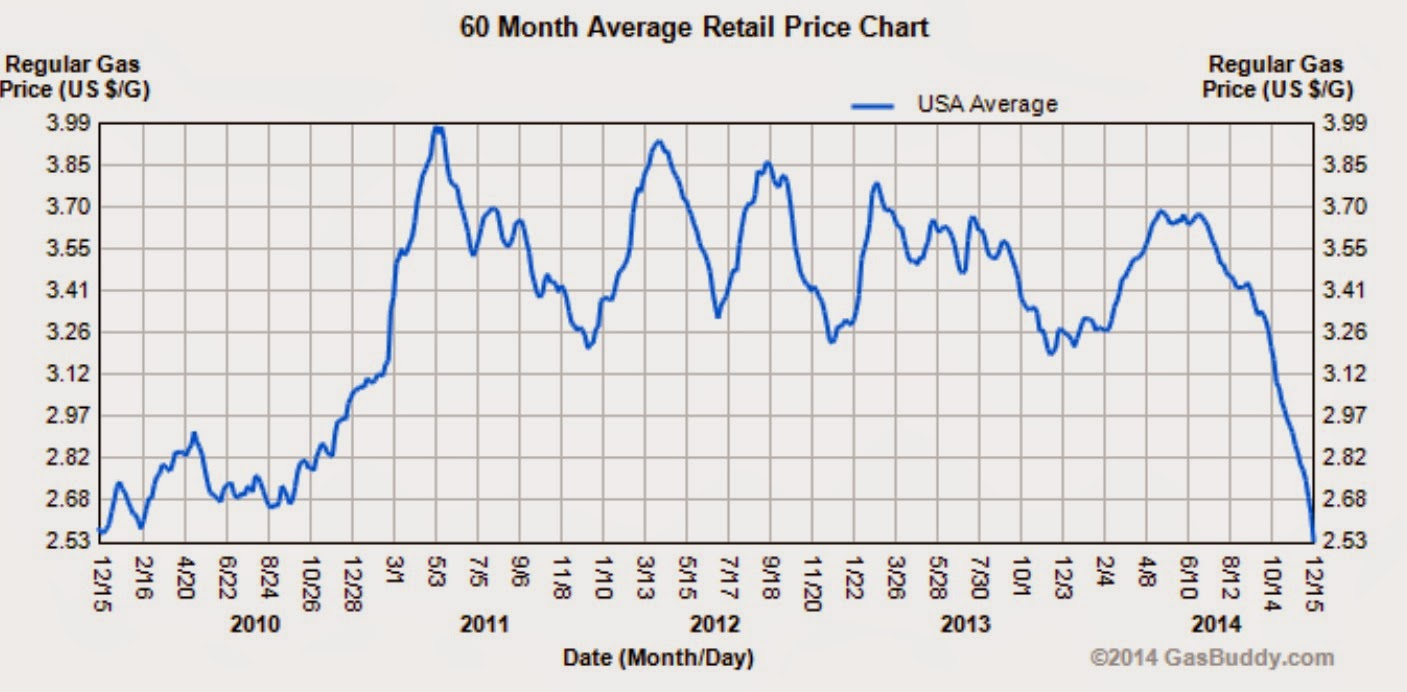
This is from GasBuddy:


Gas prices have fallen below $2.56 per gallon.  This is the lowest they have been in 5 years.

Here is an update of the price of a gallon of gas as a share of the average hourly wage:


Note this is only through November. So far in December prices have plunge another 10%. "Real" gas prices could be at a 10 year low by the end of this month, and barely above their price at the turn of the Millennium.

There is evidence this is having a pronounced effect on living expenses on lower income households.  More on that in a post later this week.

Note:  As Jeff Miller points out, just as "the cure for high prices, is ... high prices," so low prices tend to "cure" themselves as well.  I do not claim any profound knowledge as to how long these relatively low prices for gas will last. To the extent there is a political, rather than economic, reason for the Saudis in particular not to cut back on production, then as soon as the political goal has been achieved, prices might rise again quickly.  On the other hand, to the extent the moves in price have an economic basis, then, just as it took from 2008 through 2014 for exploration, conservation, and alternative fuels to break through the "Oil choke collar," it may well take a similar amount of time for those forces to reverse.

Sunday, December 14, 2014

A thought for Sunday: one step from despair


 - by New Deal democrat

[Who said: "I believe that our Great Maker is preparing the world, in His own good time, to become one nation, speaking one language, and when armies and navies will be no longer required" ?  Hint:  not a hippie.  Answer at the bottom.]

This was a horrible week for what I once thought were American values.

First we find out that letter that state officials are submitting as official "comments" to federal legislation, were in fact dictated almost word-for-word by energy companies.  Then we find out that the CIA enthusiastically embraced torture - not even to extract actionable information, but to make sure that nothing was left, or even to induce false information that could be used politically.

Finally a multi-billion dollar gift is delivered from Congress to Wall Street, repealing a provision of the Dodd-Frank Act that prohibited Wall Street banks from gambling on derivatives with their FDIC-insured deposits.  On this last bit, fully 1/3 of all Democrats in the House voted in favor, Senate Democrats are expected to follow, and President Obama is expected to sign the bill into law.

Let's be clear about one thing:  not a single word has been uttered by any lawmaker as to why this repealer is economically necessary. Wall Street banks are already making record profits.  By definition we are not talking about a farmer, industrialist, or merchant hedging against adverse contingencies.  This is strictly about gambling - with deposits that are backed up ultimately by the US taxpayer.  It is also "moral hazard" at its absolute worst.  Gains will be distributed as profits.  Catastrophic losses will be bailed out.  There is every incentive to swing for the fences.

And 1/3 of the supposed protectors of the middle/working class voted in favor?

But wait, we are told soberly by, among others, Barack Obama. Here's what the democrats got out of deal, according to Kevin Drum at Mother Jones:
In 20 years of being on the appropriations bill, I haven’t seen a better compromise in terms of Democratic priorities. Implementing the Affordable Care Act, there’s a lot more money for early-childhood development — the only priority that got cut was the EPA but we gave them more money than the administration asked for....There were 26 riders that were extreme and would have devastated the Environmental Protection Agency in terms of the Clean Water and Clean Air Act administration; all of those were dropped. There were only two that were kept and they wouldn’t have been implemented this fiscal year. So, we got virtually everything that the Democrats tried to get.
The ... full-year appropriations legislation for most Government functions [ ] allows ... authorities and funding provided to enhance the U.S. Government’s response to the Ebola epidemic, and to implement the Administration’s strategy tocounter the Islamic State of Iraq and the Levant, as well as investments for the President’s early education agenda, Pell Grants, the bipartisan Manufacturing Institutes initiative, and extension of the Trade Adjustment Assistance program.
In other words, the democrats got funding - for one year - for favored programs.  The republicans permanently killed a provision keeping Wall Street from gambling with FDIC-insured deposits.

Imagine you want to throw a party for your graduating senior.  You expect the party to get a little raucous, and you don't want trouble, so you go to your difficult neighbor and ask him to agree.  He agrees, but only if you agree to deed over to him 5' of your yard.  You got something temporary. He got something permanent. Sound like a deal?  Well, that's akin to what those guardians of the little guy and gal just agreed to.

Mark my words, those same cuts will be demanded by the GOP next year.  And the protection against gambling with FDIC insured deposits will still be gone, so another demand will be made of the democrats to save the cuts.

When it comes to American history, the scales fell from my eyes long ago. Andrew Jackson and Manifest Destiny virtually defined the 19th Century.  If native tribes had to be slaughtered, well, too bad for them.  The effort to expand slavery West and South (to Cuba, Mexico, and the Caribbean) were centerpieces of the Jacksonian dogma.

And torture?  Been there, done that, in the Phillippine - American War of 1899 - 1902.  Just an example:
To force information from a Filipino mayor believed to have been covertly helping insurgents, American soldiers resort to what they call the “water cure.” After tying the mayor’s hands behind his back and forcing him to lie beneath a large water tank, they pry his mouth open, hold it in place with a stick and then turn on the spigot. When his stomach is full to bursting, the soldiers begin pounding on it with their fists, stopping only after the water, now mixed with gastric juices, has poured from his mouth and nose. Then they turn on the spigot again.
The disgust felt by many, such as Mark Twain, was unpersuasive.

In World War 2, many Americans at home wanted all Nazi and Japanese POW's killed.  They were restrained by the military, which pointed out that American POWs were also being held by Germany and Japan.

But I digress.  A couple of weeks ago, I wrote that the Presidency of George W. Bush might turn out to be as influential as that of Andrew Jackson.  That torture - even if not effective - is viewed as a legitimate tool of government, that Wall Street should unquestioningly be given what it wants - are now topics of "legitimate" discussion, even "bipartisan" approval.  The entire range of acceptable policies has been moved a full standard deviation to the right, and remained so during the presidency of the man who ran on "Hope" and "Change."

And the GOP hasn't officially taken control of the Senate yet.

I am one step from despair.  But despair will never be an option.

You want hope?  Here is the answer to the question I posed at the outset of this post.  That sentence was uttered by President Ulysses S. Grant, the General who had saved the Union, in his second inaugural speech, 1873.  There is no record of outrage from Washington insiders in response.

Saturday, December 13, 2014

Weekly Indicators for December 8 - 12 at XE.com


 - by New Deal democrat

My Weekly Indicator post is up at XE.com.

There is a stark contrast between the more internationally-influenced data vs. US domestic data.

Thursday, December 11, 2014

The Oil choke collar breaks: American consumers attack!


 - by New Deal democrat

I have a post up at XE.com about the great November retail sales report this morning.

A few Doomers have actually predicted poor Christmas sales.  Not gonna happen.

Tuesday, December 9, 2014

A look at the first 6 months of 2015


 - by New Deal democrat

I have a new post up at XE.com looking at the short leading indicators -- those that tell us the direction of the economy about 6 months out.  These should verify for us the direction forecast by the long leading indicators roughly 6 months ago.

Sunday, December 7, 2014

A Deep Question for John "Trillion Dollar Loss" Hinderaker; Isn't Obama A Genius, Too?

     By way of background, John Hinderaker of the Power Line blog was one of the many conservatives who argued that QE and government stimulus would lead to massive inflation and a spike in interest rates.  Obviously, neither happened.  Bloomberg analyzed the potential investment ramifications of this failed thinking and determined that, if you had taken this advice, you would have lost $1 trillion dollars.  Put in less formal terms, we know that Mr. Hinderaker's economic analysis would have lost you serious money.  Of course, that has not stopped him from continuing to write about economics in the ensuing years.  (Gee, I wonder is he's invested in stocks .... )

     Which leads to this observation.  Mr. Hinderaker once made the following public statement about President Bush:

It must be very strange to be President Bush. A man of extraordinary vision and brilliance approaching to genius, he can’t get anyone to notice. He is like a great painter or musician who is ahead of his time, and who unveils one masterpiece after another to a reception that, when not bored, is hostile.

He later attempted to walk the above statement back, but it's most likely this was done because of the large amount of ridicule directed at him for that statement.

However, let's assume for the sake of argument that Bush is a genius and compare the total establishment jobs performance under Bush and Obama:


Obama's overall performance is better than Bush's.

So, if Bush is a genius, and his establishment jobs performance was worse than Obama's doesn't that make Obama ... a super-genius?

Saturday, December 6, 2014

Weekly Indicators for December 1 - 5 at XE.com


 - by New Deal democrat

My Weekly Indicator post is up at XE.com.  The global slowdown is having a negative effect on a few things, but the main effect continues to look quite positive for the US.

Friday, December 5, 2014

November Jobs Report: Blowout on jobs, slight help on wages, participation still dismal


- by New Deal democrat

HEADLINES:

  • 321,000 jobs added to the economy
  • U3 unemployment rate unchanged at 5.8%
Wages and participation rates
  • Not in Labor Force, but Want a Job Now: up 8,000 from 6.537 million to 6.545 million
  • Employment/population ratio ages 25-54: unchanged at 76.9%
  • Average Weekly Earnings for Production and Nonsupervisory Personnel: up $.04 (or +0.2%) from $20.70 to $20.74 up 2.1%YoY
September was revised upward by 15,000 to 271,000. October was revised upward by 29,000 from to 243,000. The net revision was +44,000.

Since the economic expansion is well established, in recent months my focus has shifted to wages and the chronic heightened unemployment.  The headline numbers for  November show strong jobs growth, continuing the trend all this year.  Real wages are slowly trending higher - but mainly due to lower inflation.  Participation rates are barely budging.


Those who want a job now, but weren't even counted in the workforce were 4.3 million at the height of the tech boom, and were at 7.0 million a couple of years ago.  Since Congress cut off extended unemployment benefits at the end of last year, they have actually risen, and this month were 6.545 million, over 750,000 higher than they were last November.


On the other hand, the participation rate in the prime working age group has made up over 40% of its loss from its pre-recession high, although it did not change this month.


After inflation, real hourly wages for nonsupervisory employees probably rose from October to November. The  nominal YoY% change in average hourly earnings is 2.1% somewhat better than the likely November YoY inflation rate of 1.5%.


The more leading numbers in the report tell us about where the economy is likely to be a few months from now. These were flat to slightly positive

  • the average manufacturing workweek rose from 40.9 to 41.1 hours.  This is one of the 10 components of the LEI, and will be a strong positive.

  • construction jobs increased by 20,000. YoY construction jobs are up 213,000.  

  • manufacturing jobs  were up 28,000, and are up 171,000 YoY.
  • Professional and business employment rose 86,000 and is averaging a 58,000 monthly gain for the last year.

  • temporary jobs - a leading indicator for jobs overall - increased by 22,700.

  • the number of people unemployed for 5 weeks or less - a better leading indicator than initial jobless claims - increased by 56,000 from 2,473,000 to 2,529,000, compared with last December's 2,255,000 low.

Other important coincident indicators help us paint a more complete picture of the present:


  • Overtime hours rose 0.1 hour to 3.5 hours.

  • the index of aggregate hours worked in the economy rose sharply from 101.6 to 102.2

  • The broad U-6 unemployment rate, that includes discouraged workers decreased from 11.5% to 11.4%

  • Part time jobs for economic reasons decreased by -177,000 to a total of  6.850 million.
Other news included:
  • the alternate jobs number contained in the more volatile household survey increased by a mere 4,000 jobs.  The total number of unemployed rose 114,000. This will be the number seized upon by Doomers this month.  But this still represents a 2,734,000 million increase in jobs YoY vs. 2,696,000 in the establishment survey. 

  • Government jobs increased by 7,000.
  • the overall employment to population ratio for all ages 16 and above remained unchanged at 59.2%,  and has risen by +0.6% YoY. The labor force participation rate was also unchanged at 62.8%, and is down -0.2% YoY  (remember, this includes droves of retiring Boomers).

First, a note of caution about seasonal adjustments. In the last several years, November jobs reports have tended to be somewhat outliers to the upside.  While any number over 300,000 is a great number, temper your enthusiasm a little.

All of the internals of the employment survey were strong.  Job gains were across the board, revisions remained strongly positive, and aggregate hours also increased sharply.

The relative weakness is in the household report, with its small gain in jobs, which is why the unemployment rate stayed neutral.  Those who have completely dropped out of the workforce but want a job now increased yet again, and is close to 800,000 since one year ago.  If that number had not increased, the unemployment rate would be about 0.5% higher than it is.  On the other hand, those who report that they are part time for economic reasons continues to decline.

Wages increased 0.2% in November.  Prices were probably flat or possibly declined, so real wages increased by about as much.

The bottom line:  Jobs growth remains strong, part time work is ebbing compared with full time work, real wages are still increasing slightly, but participation measures remain dismal.

From Bonddad

I have only one caveat to the report, which is expressed in this table from the Bank of America/Merrill Lynch Research Report issued on the jobs number.

 
We've had solid growth in the establishment numbers since the beginning of the year.  However, since June, the participation rate has been steady and the employment/population ratio has only increased .2%.  With such strong establishment numbers, you'd think we'd be seeing a better performance in the utilization metrics.
 
Now, these numbers are revised numerous times, to the upward revisions may be coming in the subsequent  months. 
 
Just food for thought.


Thursday, December 4, 2014

Bonddad's Post-Election Rant

I'm going through one of my "God both parties really suck shit" phases.  Let's start with the Democrats who got their asses handed to them in the last election.  Obama is a terrible president.  For the last two years he's been entirely reactionary on foreign policy.  Domestically he's, well, something, but I don't know what.  The Dems desperately need new leadership and blood, but right now the Hill is managed by the old guard (they re-elected Reid and Pelosi for God's sake) and there is no meaningful state apparatus anywhere outside the NE and California.  They've abdicated the entire center of the country to the Republicans, who, when elected, slash and burn state budgets (Kansas), pass abortion and voting restrictions and little else.

What the hell to the Democrats stand for?  If you can find a consistent policy proposal, please tell me.  Because I can't find it anywhere.   And -- 35 years after Reagan -- the Democrats will haven't learned the lesson: have a few basic selling points, frame them in simple terms and find a charismatic person to sell them.  The closest things the Dems have to that is Elizabeth Warren.  While I don't agree with her on several issues, I think she's great because she's a highly articulate person who stakes out her policy positions clearly and effectively. 

Texas was a very big disappointment; Davis lost by 20%.  Some of the post mortems have been very interesting, with several noting that running a candidate who's position on abortion was the centerpiece of her campaign was a really stupid idea for Texas. And, frankly, they're right.  Houston and San Antonio do democratic mayors and ours is actually very good; Anise Parker is a pure technocrat.  The city works, and it works well.  But she's an openly gay woman who isn't that photogenic, which will probably limit her on the larger Texas stage.

The Republicans -- dear God, where do they find these people? Stupid doesn't begin to describe the dearth of intellect.  And yet, people still take them seriously.  Consider this: in 2008-2009 a number of conservative economists signed a letter saying QE would lead to hyper-inflation and spiking interest rates.  Invictus and I wrote a response to this over at the Huffington Post arguing it wouldn't.  Krugman also debunked this line of thinking.  A few months ago, Bloomberg first calculated that making an investment based on their advice would have cost you $ 1 trillion.  Next, they called these idiots to get their take on why neither had happened.  Their answer?  No change in thought!    The best response was from Amity Shales:

“Inflation could come, and many of us are concerned that the nation is not prepared.”
“The rule with inflation is ‘first do no harm.’ So you always want to be careful.”

Translation: I'm going to write a few sentences that contain the words inflation in the hopes no one will notice that I'm untrained in economics." 

And then there's their whole stance on climate change.  Here's a question for them: they keep saying that global warming is a liberal plot. OK -- assume that to be true.  Why hasn't Fox news and Rupert Murdoch created a giant "there is no global warming" convention to write a giant paper in response to the UN's climate change paper?  They've had 10 years to do it and haven't.  That tells me in no uncertain terms that the "there's no change" crowd is full of it.  And yet, they continue to spout their crap and no one calls them on their bullshit.

And what is their response on health care to the ACA?  Nothing that would come even close to working -- and they've had 4 years to come up with something -- hell, anything.  For God's sake -- OmamaCare is Roomney Care which is based on several bedrock Republican concepts from the 1993 response to Clinton's health care reform.  And yet, now the ACA is somehow bad despite the dropping rate of uninsured people in the country and slowing down of overall health care costs.

And this is before we get into their long-standing desire to turn the science classroom into a theological indoctrination platform where the earth is only 6,000 years old and evolution is only a "theory."

So, on one side, we have Democrats who don't really stand for anything and who have an aging and more and more ineffective leadership.  With the Republicans we have a pool of people who represent the largest known pool of collective stupidity we've ever seen. 

What's there to be happy about?  

October housing: green across the screen for 2015 (at XE.com)


 - by New Deal democrat

I have a new post up at XE.com, detailing all of the October housing reports, and showing why they are adding to my optimism about 2015.

Tuesday, December 2, 2014

That Thanksgiving weekend 11% decline in retail sales ... didn't happen


 - by New Deal democrat

The usual suspects (We're DOOOOMED!!!) have picked up on media reports that allegedly US holiday sales over the post-Thanksgiving weekend slid by 11% compared with last year.

There's just one little problem with that assertion:  It didn't happen.  Click on over to XE.com for the gory details.

Monday, December 1, 2014

Gas prices vs. average hourly wages


 - by New Deal democrat

One of my goals is to bring you "value added," in other words, rather than simply updating you on the day's data releases - there are a slew of sites that do that - I want write about important topics that I think are being overlooked.

That's why I have harped so much on the price of gas over the last 5+ years.It was in no small part because of $4.25/gallon gas in June 2008 that the American consumer threw in the towel, intensifying what had previously only been a mild downturn, if that.  Similarly, $1.45/gallon gas in December 2008, in the very teeth of the general cliff-diving, marked the point where consumer spending stabilized.  This suggested that downturn might hit bottom at or about the anniversary of that $4.25 peak (as YoY consumers had significantly more to spend).

Thus the seasonal return to nearly $4/gallon gas in 2011-2014 put pressure on workers, who pay growth was barely keeping up.

How much pressure?  Here is a graph of gas prices deflated by average hourly wages - in other words, what percent of an hour does the average worker have to work, to afford a gallon of gas:


As you can see, this was more or less steadily rising from 1999 through summer 2008.  It more or less stabilized near that peak for the last 3 years. Note that the above graph ends in October.  Since gas prices fell on average close to 10% during November, we can expect a value a little over 0.14 once the jobs report is released this Friday.

The relationship between gas prices and GDP is not linear. In general, up to a point (approximated at $4/gallon over the last 10 years in the graph below, red), the lower the price of gas, the higher the quarterly GDP (blue).  Once the recession began, however, lower gas prices correlated with lower GDP.


The bottom line is that this quarter's lower gas prices should lead to higher GDP, perhaps not in this quarter, but very likely by Q1 2015.

10 year gas chart


 - by New Deal democrat

The below graph comes from GasBuddy, showing gas prices for the last 10 years:


See that upward spike way over by the left?  That's Hurricane Katrina, which knocked out refineries in Louisiana for several weeks. Gasoline is now less expensive than any time since except for winter 2005-06 and 06-07, and 2009 - and almost as cheap as most of 2010. Put another way, it is closer to its 10 year low than its 10 year high.

Here's a graph showing how $65/barrel Oil (its price as of Friday) (blue, left scale) translated into gas prices at the pump (red, right scale) in the 2005-07 period:


At current Oil prices, I would expect gas prices at the pump to settle somewhere between their current level of   $2.76 and $2.60.

I have no idea how long this is going to last.  But it is almost half as big a stimulus as the crash in prices that put a  bottom in for the late 2008 consumer collapse in the Great Recession.


Sunday, November 30, 2014

A thought for Sunday: the 10 most influential presidencies


 - by New Deal democrat

You know the drill.  It's Sunday, so I get to ruminate on whatever.  Regular economic blogging will resume tomorrow.

In the last couple of years, one of my conversation starters is to ask a fellow fossil:  Who has been the most influential president(s), for good or bad, in your lifetime?"  Almost always, at the top of the list is Lyndon Johnson, with Ronald Reagan second.  Now, Reagan seems like an obvious choice, but 40 years ago I doubt very much that those then-young Boomers would have thought that the Johnson's economic and immigration policies would define their America.

So, that got me to thinking of expanding the list to the entire line of presidents.  Who, whether for good or ill, defined the country for generations to come by actions or policies they undertook during their presidency?  Note that this eliminates some presidents, like Madison and Grant, who were crucial, but not for what they did during their presidency.

So, here's my list of the 10 most influential presidencies, in chronological order:

1.  George Washington.  He could have assumed the power of a dictator, or set himself up at the head of a monarchy, but unlike future Latin American heroes, he left office after two terms and returned to his farm, setting the precedent of a peaceful turnover of power after 8 years.

2. Thomas Jefferson.  He did many things during his life, but what gets him on this list is the Louisiana Purchase.  Nobody even knew if this was Constitutional or not - although the Congress subsequently ratified the purchase - but with this bold stroke he established the US as a continental empire.  Secondarily, his Democratic Republican Party was the first fully partisan electioneering engine, establishing dominance in the Congress as well as the Executive for a quarter century.

3.  Andrew Jackson.  Decisively and permanently shifted the balance of governing power from the Congress to the Presidency, by appointing partisan supporters to every office controlled by the Executive, and also via thorough use of the veto. The first 6 presidents used the veto power very sparingly, but Jackson vetoed every act passed by Congress that he did not 100% support, and almost always got his way. His spoils system strengthened Jefferson's party system, and his faction became the Democratic Party, which controlled the White House until 1860.

4.  James Polk. If the first three members of this list seem obvious, Polk shows the difference between "influential" and "good" or "great."  He gets on this list, quite simply, for the annexation of Texas, the definitive acquisition of the Oregon territory, and the Mexican War.  When Mexico wouldn't sell him California, he determined to take it by force, and obtained what is now the entire American southwest via that victory. After Polk, the US stretched all the way from the Atlantic to the Pacific.

5. Abraham Lincoln. Preserved the Union after the South seceded.  Using the legal theory the groundwork of which was laid by John Quincy Adams (whose presidency was inconsequential, but whose lifetime achievements were great, and largely shamefully forgotten), Lincoln used his powers as Commander in Chief to issue the Emancipation Proclamation, and secured the passage of the 13th Amendment, abolishing slavery. And secured the position of the Republican Party.

6. Rutherford B. Hayes.  "His Fraudulency," who like George W. Bush secured election even though he lost the popular vote, traded away Reconstruction and racial civil rights for his election.  Eighty years of segregation, Jim Crow laws, poll taxes, lynchings, and the KKK followed.  A thoroughly shameful, but decisive, presidency, the effects of which lasted an entire lifetime thereafter.

7.  Theodore Roosevelt.  The first great economic progressive President.  Developed the "Square Deal,"  pursuant to which he used the Sherman Antitrust Act 45 times to break up monopolies. established the FDA, and established the first National Parks.  And had the Panama Canal built as well.

8.  Franklin Delano Roosevelt.  The New Deal.  Commander in Chief during the Second World War (which, unlike the First World War, ultimately was a war for survival).  His US Supreme Court appointments established the modern understanding of the Commerce Clause, giving the federal government wide scope to act regarding the economy.  His New Deal coalition was dominant for about 40 years.

9.  Lyndon Johnson.  In 1968, the Vietnam War overshadowed his entire presidency.  But 50 years later, the US remains the country of Medicare, Medicaid, the Civil Rights Act, the Voting Rights Act, and the Immigration Act (which decisively shifted immigration permits away from Europe).  Public broadcasting, the National Endowment for the Humanities, the Clean Water Act, and a host of conservation laws are still with us as well.  Despite the best (or worst) efforts of the GOP ever since, these all still survive and define modern America.

10.  Ronald Reagan. In my opinion, the 20 most dangerous words ever uttered by a President were "The 10 most dangerous words in the english language are, 'Hi, I'm from the government, and I'm here to help.'"  Reagan successfully brought the GOP's "Southern Strategy" to fruition, established a generation or more of GOP dominance, and perhaps most decisively, caused a majority of Americans to think of their government not as providing for the general welfare, but as an alien entity. Getting a majority of Americans to turn their backs on the Square Deal and the New Deal was quite an accomplishment, and 35 years later, little of their economic reforms survive as viable policies.

That's my list of 10.  It's too soon to judge, but if the next president does not reverse George W. Bush's national security state and tax policies, he is probably going to join this list, for good or ill, as the first 21st century member.
Saturday, November 29, 2014

US Equity Market Week in Review For the Week of November 24-28

     One of the great benefits of having multiple equity averages is that they almost always confirm each other; for example, when the SPYs rally, the QQQs follow suit which implies the markets are most likely moving higher.  But this week we have a fascinating situation: the QQQs rallied, the SPYs moved sideways and the IWMs fell.  This essentially gives everybody from the most bullish to the most bearish something to base their opinions on.
 
     Let's start by looking at the SPYs:
 
 
First of all, remember this was a holiday shortened week with a shortened trading session on Friday.  But for most of the week prices remained in a narrow area between ~207 and 207.5.  Prices moved higher on Friday, but then trended lower for the last half of the trading session.


The daily chart shows prices gapping higher a week ago Friday in reaction to the ECB and PBOC adding stimulus followed by prices moving sideways. 
 
 
In contrast we see the QQQs, which moved higher for the first half of the week, gapped up on Friday's OPEC news and then sold off to a price near their open on Friday.
 
 
But on the daily chart prices clearly remain in an uptrend.
 
 
The IWMs mirrored the QQQs for most of the week, printing a slow by solid rally.  However, on Friday, prices sold off sharply, closing near their lows for the shortened trading week.
 
 
The daily IWM chart shows the sharp price drop on Friday.
 
     So -- what does all this mean?
 
     Let's begin the analysis by noting that odd things are more likely to happen in a holiday shortened week because there are fewer traders in the market.  And the sharp sell-off on the IWMs was most likely caused by no one wanting to hold a position over the weekend as a result of chaos in the oil market.  Assuming that to be the case, the most logical conclusion is the QQQs are driving the market higher and they will pull the SPYs and IWMs up over the next few weeks.  This makes more sense considering the overall stimulating effect of lower oil prices on the economy as a whole (which was also confirmed by the transports gapping higher on Friday as well).            
 
     But at the same time, we're still dealing with the limiting factor of a fairly expensive market as shown by this table from the Wall Street Journal:


The Dow is at 17 while the S&P is at 19.4 and the NASDAQ is at 25.  All three of these readings are high from a historical perspective and limit upside advances.


Weekly Indicators for November 24 - 28 at XE.com


 - by New Deal democrat

My Weekly Indicators piece is up at XE.com.

There was more than one very sharp positive.  But a few cracks appeared in the facade as well.

Thursday, November 27, 2014

Happy Thanksgiving - and an economic fact to be thankful for


 - by New Deal democrat

Best wishes for a very happy Thanksgiving.

Here is a little wonky economic thing we can be thankful for.  Since the end of WW2, Typically real GDP growth (blue) outstrips job growth (red) by about 2% on an annual basis:


But in this expansion, GDP growth has only exceeded job growth by about 0.5%.

If the usual relationship held in this expansion, we would only be adding about 50,000 jobs a month instead of 200,000 jobs a month. We would have added 1,800,000 fewer jobs in each of the last 3 years than we actually have.  That is something to be thankful for.

Wednesday, November 26, 2014

A note about the housing market for October


 - by New Deal democrat

A slew of housing data for September and October was reported yesterday and this morning.  I'll try to have a long, more involved piece either on Friday or Monday, but in the meantime let me give you a few comments.

To begin with, let me reiterate that I pay so much attention to this market because it is the single most leading sector of the economy.

When interest rates increased by about 1.5% in mid-2013, I forecast that the housing market would stop growing and would even turn down this year.  That it did, making a trough at about the end of last winter.  Since then it turned up, but only at a very low rate.  Generally multi-unit properties are being construted at a slightly faster rate than single family homes, which have stagnated.  Meanwhile prices generally have continued to appreciate, although there are signs that these too may actually have turned down earlier this year before starting to appreciate again.

The latest data continues that trend.  Last week we already found out that while the more volatile housing starts number was deemed slighly disappointing, housing permits (which tend to be about a month ahead of starts) made a new post-recession high.  Today single family home sales were reported equal to their post recession high, made a little more than a year ago.  For the last few months they have been generally slightly positive YoY.  The less important existing home sales were positive YoY for the first time in many months yesterday.  Pending home sales declined from September, but were also have turned postive YoY.

All of the house price numbers are positive YoY.  The Case-Shiller index, however, has failed to make a new seasonally adjusted high since April.  It did increase month over month.  The median home prices of both new and existing home sales appear to have both re-accelerated after making a trough during the third quarter.

Mortgage rates continue to decline, with 30 year rates under 4% again.  This tells me that home sales will continue to improve, and are likely to improve a little more vigorously, in the months ahead.  And because housing is such a leading sector, this has made me increasingly optimistic about the economy, jobs, and wages next year.


Tuesday, November 25, 2014

Good news and bad news for workers: corporate profits rose in third quarter


  - by New Deal democrat

The BEA's revised release for 3rd quarter GDP included its calculation of corporate protifts, which rose 1.5% over the 2nd quarter, and once again made an all time high.

This is both good news and bad news.

The good news is that corporate profits, deflated by unit labor costs, also made a new high. This is a long leading indicator, meaning that it usually starts to decline one year or more before a recession starts. This in turn means that more jobs should continue be added to the eonomy over the next year.  Companies with shrinking profits do not hire new workers; companies with increasing profits do.

The bad news, of course, is that corporate profits continue to monopolize virtually all of the monetary gains since the economy started to expand in the second half of 2009.  Wages are still not sharing in the bounty.

I'll have more at XE.com later, and I'll post a link  UPDATE:  Here's the link.  I discuss this release in the broader context of the economy. It is virtually across the board good news.

Sunday, November 23, 2014

Gasoline "Breaks on through to the Other Side"...

... of the oil choke collar.

 - by New Deal democrat

This is from Gas Buddy this morning:


The price of gas has fallen to $2.82 a gallon.  That is lower than at all times in the last 4 years.

Remember that for every $0.10 gas prices decline, after you factor in the typical mileage driven for a vehicle, times the number of drivers in the US, that is something like another $36 billion a year that consumers can save or spend on other goods.

Update:  Here are a few statistics to help understand how much the US consumer is saving on gas.

The average vehicle in the US is driven 11,318 miles/year:

http://www.epa.gov/cleanenergy/energy-resources/refs.html

The average gas mileage in the US fleet is about 24 miles per gallon:

http://www.washingtonpost.com/blogs/wonkblog/wp/2013/12/13/cars-in-the-u-s-are-more-fuel-efficient-than-ever-heres-how-it-happened/

There are about 250 million vehicles in the US:
http://www.latimes.com/business/autos/la-fi-hy-ihs-automotive-average-age-car-20140609-story.html

That's about 9 billion gallons of gas per month total in the US.

Every 10 cent decline put $900 million dollars a month in consumers' pockets.

Gas now is about 35 cents a gallon cheaper than it was last November. That means about $3 billion dollars this month that can be saved or spent elsewhere.