- by New Deal democrat
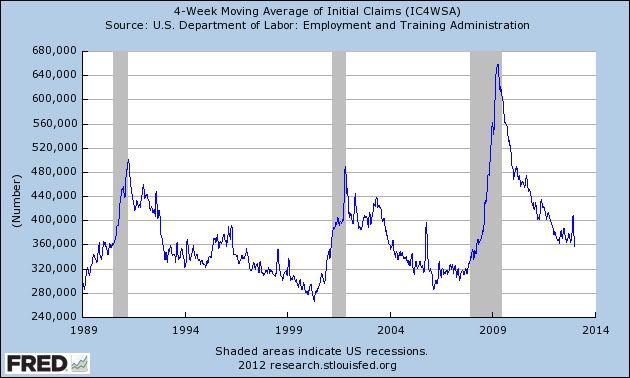
Initial jobless claims are generally acknowledged to be a short leading indicator for the economy. With this morning's report of 350,000 new claims being filed last week, the 4 week average fell to 356,750. This is the lowest 4 week average in nearly 5 years! In the nearly 50 year history of initial jobless claims data, there has never been a new low in initial claims set during a recession.
Back in July I took a look at the historical record. In all cases but one since records started to be kept back in the 1960s, initial jobless claims rose 10% from their lows before a recession began. The lowest increase was 5%. Once recessions have begun, the number of claims rose inexorably. The shortest period of time between the low in claims and the onset of recession was 2 1/2 months.
While we did have two weeks post-Sandy where initial claims were more than 10% above their previous post-recession low of 363,000, my calculations have shown that ex-Sandy, the four week average of new claims would only have risen into the low 370,000s range.
While initial jobless claims are only one indicator, it is unheard of for claims to be falling to new lows unless the economy is expanding, and is strong evidence against any thesis that a recession began earlier this year.
P.S.: The data for one week ago suggests that the effects of Sandy have almost completely dissipated. Combined NY and NJ claims one week ago were 9.4% of all claims filed, vs. 9.0% one year ago, and vs. 8.9% in October before Sandy struck. At worst, Sandy may have had about an impact of about 1000 claims.
P.P.S.: I'll update with a graph showing today's data once it is available. UPDATE:Here's the graph, starting in 1989 to compare the typical pattern, and showing this week's new post-recession low at the very end:

7 comments:
I notice that many(all that I have seen) of your 'we are not in recession' conclusions have been drawn from looking at this or that data point and then putting it into the context of other data readings/recessions over the past 50 years.
But the current malaise is unlike any since the Great Depression. So it seems phony to repeatedly dismiss a current recession based on this apples-to-oranges comparison with more recent (last 50 yrs) recessions and then using that flawed logic to draw the conclusion.
I am not arguing that we are or are not in recession currently. I am simply observing that many of the recent conclusions posted here (and admittedly I may have missed some more carefully crafted conclusions along the way - I only visit occasionally) are drawn from this flawed comparison of current conditions to other time frames (last 50 yrs) that are not comparable.
Pacioli, you go with the data you have not the data you wish you had.
You refer to flawed comparison and apples to oranges comparison but you sure haven't proved your case. Stating your position doesn't prove it.
@ Anon:
As I clearly stated in my original comment, "I am not arguing that we are or are not in recession currently."
So it makes no sense to say "you sure haven't proved your case."
I am asserting that the blog author has not proved anything either.
I was referring to your use of "flawed logic", "flawed comparison" and "apples-oranges" when I suggested you haven't proved your case. Frankly, recessions are not all equal but that doesn't mean statistical comparisons are not still useful. And blog author hasn't suggested this as proof, just strong evidence.
We're not in recession. How much longer will this blog keep trying to prove it. What's next? The sky is still blue.
There are permabears out there. I myself don't understand the data on a deep enough level to make definitive statements as to who's right or wrong. But as long as those people are out there, it seems reasonable to me that Hale and company would point out that the new jobless claims contraindicate their claims.
http://bit.ly/VuV2qn
Post a Comment