Monday, September 7, 2009

Maufacturing leads Recovery, but Jobs mired in Recession

- by New Deal democrat

Like a roller coaster at the bottom of that terrifying first drop, the leading part of the economy has turned up, but the lagging part continues to drop. That's the message from this past week's economic statistics, which focused heavily on manufacturing and jobs. Manufacturing has surged into growth. Jobs continue to decline and unemployment claims are stubbornly high. As to whether we will have a V-shaped jobs recovery, or a "jobless recovery" that requires strong GDP growth just to generate a single additional new job, the answer appears to be, "both." I'll explain why that is below the fold.

I. Manufacturing has surged into growth

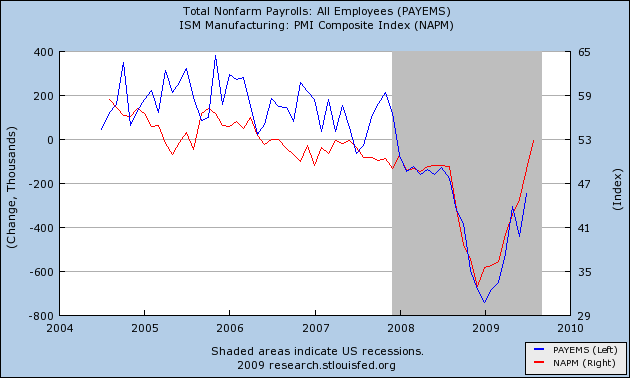
This is likely to be an old-fashioned recovery, where manufacturing leads the way. This past week we got a slew of data about the strength of the manufacturing rebound. Most importantly, the Institute of Supply Management's manufacturing index recorded outright growth, it's reading of 52.9 (above 50 indicates growth) was not only significantly higher than estimates, but according to the ISM, "the highest since June 2007." The new orders index likewise surged, "up 9.6 points to 64.9 percent, the highest since December 2004." The deliveries index, a leading indicator, also improved to 57.1. Inventories shrank, meaning that replacing goods on shelves will require more manufacturing in the future.

here's the chart:


The ISM index confirmed prior readings of expansion by the Federal Reserve Bank districts of New York:
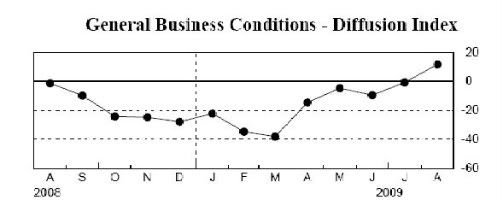


Philadelphia:
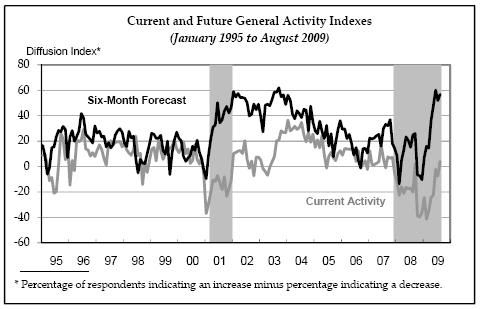


and Richmond:
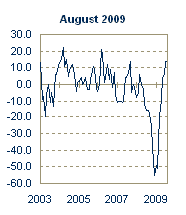


And Reuters reported that:

A similar index covering the heavily industrialized Milwaukee region rose to 56 in August from 45 in July,


Auto and truck sales also showed a dramatic "pop" due to "cash for clunkers," and factory orders and durable goods also showed strength,


although new orders for consumer nondurable goods, the only poor item of data, declined 1.9%, remaining the only leading indicator not to have turned up in the last 6 months.

Yesterday's report showed that manufacturing workweek and overtime were steady, neither improving nor declining from July.


In short, this week the data began to paint the picture of a robust recovery in manufacturing

II. But employment and unemployment data remain weak.

While manufacturing strengthened, this did not feed through into job growth. Yesterday the BLS reported that the US economy shed ( - 216,000) jobs in August, a modest improvement over July's negatively revised ( - 276,000).
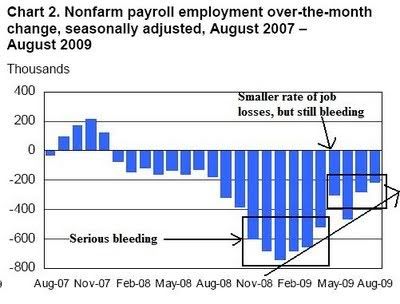


This was in line with private reports from earlier this week, and the Institute for Supply Management's manufacturing and non-manufacturing surveys, which showed similar improvement but still more businesses laying off than hiring.

Meanwhile, new jobless claims remain stubbornly high at about 570,000 a week (seasonally adjusted). That means that there is a gradual increase in hiring taking place, but not enough to offset the continued firing of employees. Employers simply aren't ready to add new workers yet. Instead, they're handling increased orders by working existing employees harder.

Still, both trends (of jobless claims and payroll unemployment) are moving in the right direction. For example, as in past recessions and recoveries, the sequence is that initial claims peak first, then 5-14 weeks' continuing claims, then 14-26 weeks and finally 27 plus weeks, the last one usually after the recession is over (blue, then orange, then green, then red in the graph below). Not only is the same sequence followed now, but for the first time there is evidence that claims of 27 weeks plus are peaking (which typically only happens once the recession is already over):


Further, in every prior recession, mean duration of unemployment has peaked at or after the end of the recession:

Notice that mean duration of unemployment has already peaked in 2009.

Nevertheless, these employment and unemployment reports show continued pain, and especially given the huge number of people who have been unemployed for a very long period of time. Most significantly, there a more longer term unemployed now than during any post World War 2 recession.


III. How manufacturing strength and job weakness fit together

In Part I above I highlighted the ISM manufacturing index, which surged from contraction to expansion in August. How well does this index's reading of expansion correlate with job growth? As it turns out, manufacturing growth and increased employment correlate very well. This tells us a lot about what to expect in the next few months. Let me show you how well the two data series fit, below.

First, here is a graph covering the years 1969-1983, including 4 recessions and recoveries. The jobs numbers are in blue, left scale, and the ISM manufacturing index is in red, right scale:
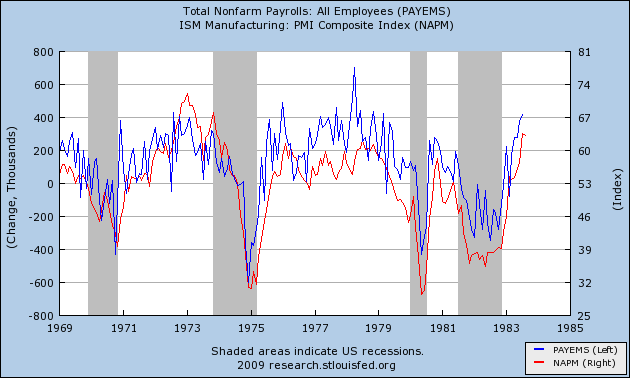

First of all, notice how closely the two series correlate with one another. If you are having any problem reading the squiggles, here's what they show: in these traditional recoveries, with a few months during the 1970-71 recession and recovery, an ISM manufacturing reading above 50 almost perfectly correlated with actual job expansion. For example, the 1982 deep recession (which featured U3 unemployment over 10%) ended in November 2002. Here are the next ISM manufacturing readings:

1982-12-01 42.8
1983-01-01 46.0
1983-02-01 54.4 ( -78,000)
1983-03-01 53.9 +173,000
1983-04-01 54.2 +276,000
1983-05-01 56.1 +277,000

Notice that the first month of growth shown by the ISM index nevertheless coincided with a negative jobs number. Keep that in mind later.

Next, let's look at the graph for 1989-2004. This includes our two previous "jobless" recoveries:
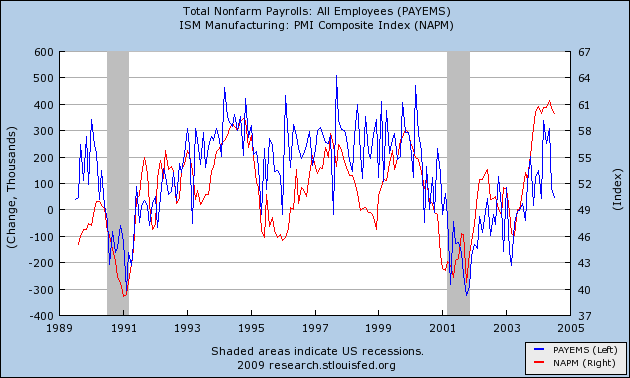


Once again, the correlation is striking, but this time -- particularly after the 2001 recession -- there were some weakly positive ISM readings that nevertheless were accompanied by negative jobs reports. This is because both were very weak manufacturing expansions. In contrast to the 1950s-1970s recoveries, at no time during either of the more recent "jobless recoveries" was there an ISM manufacturing index reading of 54.0 or above

Let's look at them in turn. The 1990 recession ended in March 1991, but employment declined until May. Unemployment didn't peak until June 1992. Although throughout that period, typicially the economy did add jobs, unemployment still rose. You need ~150,000 new jobs every month to keep up with population growth, and the recovery wasn't strong enough.

The ISM manufacturing index first turned positive in June 1991, turning negative for 3 months at the end of the year, before rebounding again. During the period betwen June 1991 and the June 1992 peak, ISM readings above 50 meant positive jobs data with two exceptions:

1991-07-01 50.6 (-47,000) (only the second month after it turned positive)
1992-02-01 52.7 (-66,000) (the first month after the index turned positive again)

Aside from that, a positive ISM reading correlated perfectly with positive jobs data.

Next, let's look at the 2001 recession. Despite ending in November 2001, unemployment did not peak until June 1993, and employment continued to decline until August 1993. This time, the "recovery" was so weak, job growth was almost non-existent.

The ISM manufacturing index first turned positive in February 2002. During the period betwen then and August 2003, the ISM index vacillated between expansion and contraction, never recording a higher number than 53.6 in June 2002. There were a number of negative job readings. Here are the two worst along with relevant subsequent months:

2002-02-01 50.7 ( -147,000) (the first month after the ISM index initially showed growth)
2002-03-01 52.4 (-22,000)
2002-04-01 52.4 (-85,000)
2002-05-01 53.1 ( - 7,000)
2002-06-01 53.6 +45.000)
----------------------
2002-12-01 51.6 ( -156,000) (the first month after it rebounded into growth)
2003-01-01 51.3 +83,000

Finally, let's look at the recent "Great Recession" and the present incipient recovery:


Notice again how well the two series correlate with one another. In this, our first month after manufacturing returned to growth, the economy subtracted ( -216,000) jobs.

You may recall that I showed a few weeks ago how "Okun's law" about GDP growth and job growth appeared to have been "broken", or at least changed. Since about 1995, it takes 2% GDP growth to add a single net job to the American economy. Here's the graph I used then:
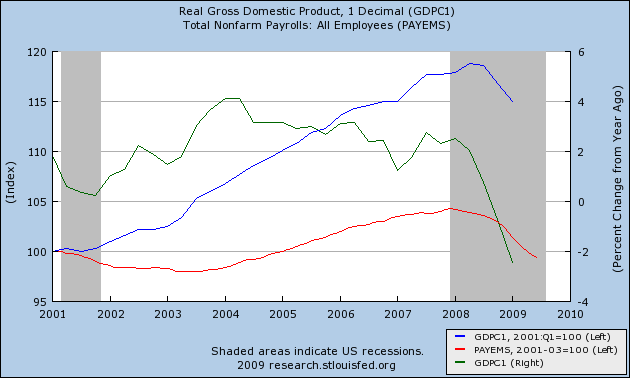
The recent initial jobless claims, payroll, and unemployment data strongly indicates that those metrics remain true. Merely having manufacturing return to growth isn't enough to generate new jobs. The growth must be strong enough to overcome the drag of outsourcing and "productivity." So, will it be?

IV. The Leading Economic Indicators will probably print positive for the 5th straight month in August

The very same data that told Bonddad and me four months ago that the economic free fall was going to stop, and that has ever more strongly pointed to recovery, the Leading Economic Indicators, are now known for August, and it looks like it will be another decent month. I'll spare you the multitude of graphs, but here's the list (with my estimates of their contribution to the index):

The yield curve is still positive +02
Stocks' 3 month gain is worth +0.1
New home sales are worth about +0.1
Durable goods' strong growth add +0.2
Consumer sentiment adds +0.1
ISM deliveries up strongly, adding +0.1

Aggregate hours in manufacturing were unchanged 0

Jobless claims were slightly worse -0.1
Real M2* has been trending slightly negative, so -0.1
Consumer nondurables down strongly -0.2

Bottom line: it looks like August Leading Economic Indicators (and revisions to July) will net about +0.4, the fifth positive reading in a row.

Finally, just yesterday, the Economic Cycle Research Institute, a forecasting service that dates to before the Great Depression,
reiterated its very bullish stance:
A weekly measure of future U.S. economic growth rose in the latest week, while its yearly growth rate surged to a 38-year high that suggests the recovery is on track.

The Economic Cycle Research Institute, a New York-based independent forecasting group, said its Weekly Leading Index rose to 124.7 in the week to August 28 from a downwardly revised 124.3 in the previous week, originally reported as 124.4.

The index's annualized growth rate rose to 20.8 percent from 19.6 percent a week earlier. The latest reading was the index's highest yearly growth rate since the week to May 21, 1971, when it stood at 21.3 percent.


Conclusion: To the Question, "Will it be a V-shaped jobs recovery, or a 'jobless recovery'", the answer seems to be "Both."

To sum up:

1. Job loss in the recession -- about 8 million and wiping out an entire decade of growth -- has been terrible and remains persistent even as the leading parts of the economy -- housing and manufacturing -- have actually started to grow again. Unlike the earlier post-World War 2 recoveries, in the past decade it has taken strong economic growth of 2% or more just to generate a single new American job. The indications certainly are that the same headwind - aided and abetted by offshoring - persists and will remain a blight on the economy.

2. Meanwhile, manufacturing has undergone a breathtaking turnaround. The manufacturing index's average change of +3.3 in the last 5 months is a stronger move than in either of the two previous "jobless recoveries." In the 2002-3 recovery, manufacturing stalled out, never raising the index above 53.6. In contrast, in early 1983 the manufacturing index quickly rocketed to 56.1, adding a quarter million jobs in that month. That is the same type of growth that ECRI is predicting in the quote above.

3. We will probably continue to experience job losses if housing and manufacturing stall out here.

4. But the ISM deliveries subindex is part of the LEI, and that index continues to move in a positive direction.

5. So in conclusion, the odds favor the manufacturing index continuing to rise in the next several months, and if that happens, then despite the headwind of needing to have 2% GDP growth to generate jobs, we may nevertheless see job growth shortly.
================

Post Script: Conclusively proving that I Have No Life, I have spent considerable time since I drafted the above looking for a better leading indicator for when job growth did ultimately occur after the 1991 and 2001 recessions. Part 3 above is a good first stab at it, I think, but I would like to be more confident in that part of the analysis. In other words, hopefully a more refined analysis with more confident conclusions, soon.

Markets are Closed

and so am I. I'll be back tomorrow.

Friday, September 4, 2009

Weekend ... Pitbull


Say hello to Max. I found him a few days ago when I was running. I ran by the parking lot of out favorite bakery and there he was. He was limping on his right rear leg and he was about 10-15 pounds underweight. As I was looking at him I told him, "I'm not finishing my run today, am I?" The answer to that was no.

We don't know what caused his right rear leg problems, but we (me, Mr$. bonddad and the vet) think he was hit by a car. The ball has been shattered. But there is an operation to get him healed up that we're going to do a week from Monday.

But -- here's the problem. We already have three dogs and we just don't have room. Max is about 1 to 1 1/2 years old and is really nice. He is strong, but that's a breed trait. Once you sit him down and start petting him he will lick your face just like a puppy.

So -- for all the bonddad blog readers who are also dog fans -- we could use your help. If you are interested in taking him in, please leave a comment below. We will happily work with you to get him where he needs to go.

Thanks for helping if you can. And spread the word -- max needs a home.

More On the Unemployment Numbers

First, consider that at the beginning of this year we were losing 600,000+ a month. Now, let's assume a gradual easing of those problems at at 50,000/month rate. That would get us to a current level of a 250,000/month loss rate which is slightly worse than where we are currently. Here is the point of this exercise: an economy that is shedding jobs at a 600,000+ rate does not turn around and start creating jobs within 6 months; it just does not happen. An economy that goes through a period of losing 600,000+ jobs/month can more or less expect to have a dead year ahead. That -- simply put -- is reality. Today's figures are on track with a slow but steady improvement in the establishment jobs market. At the pace we are going we should be printing right around 0 within 6 months.

In addition, consider these charts of the length of time people are unemployed:


The number of people unemployed for less than 5 weeks have been decreasing since the beginning of the year.


The number of people unemployed for between 5 and 14 weeks increased in today's report. But


The number of people unemployed for 15-26 weeks declined again and


The number of people unemployed for more than 27 weeks increased but at a far slower rate than previously.

In other words, of 4 different lengths of time that people are unemployed we saw improvement in three of the metrics. And one of those time frames -- the less than 5 weeks period -- has been decreasing since the beginning of the year. That means we can probably expect to see continued improvement in these numbers going forward.

Establishment Job Losses at (-216,000)


Click for a larger image.

The chart reveals the following points. First at the end of last year and the beginning of this year the economy was bleeding jobs. Four months ago the rate of job losses decreased from roughly 610,000 on average to about 225,000 on average. In other words, the pace of job losses is still decreasing which is good. However,


The unemployment rate increase .3%. The reason is illustrated in the following chart:


Click for a larger image.

The unemployment rate comes from the household survey which shows in increase in the civilian labor force of 73,000 and an increase in the number of unemployed of 466,000.

The above chart also shows that the rate of decrease in various job sectors is moderating. Note the month over month losses are -80 for service industries and down -136,000 for goods industries.

There are three other interesting data points.


The number of people working part-time for economic reasons has leveled off since the beginning of the year.

The number of people marginally attached (These individuals were not in the labor force, wanted and were available for work, and had looked for a job sometime in the prior 12 months.) is increasing. And

The number of discouraged workers (Discouraged workers are persons not currently looking for work because they believe no jobs are available for them) may have topped out for this cycle as well.

Overall I'd call this a lukewarm report. I don't like the increase in the unemployment rate, but it's not surprising. The overall rate of job losses are still moderating, the rate of individual losses in various industries are decreasing and two measures of labor under-utilization (part-time for economic reasons and discouraged workers) appear to be topping.

Forex Fridays


The weekly chart is interesting. While prices have been dropping, there are three elements to this chart possibly pointing to a rebound. First, the MACD is approaching a buy signal. Secondly, the RSI is at low levels (although it could still move lower). Finally, prices aren't moving lower in a solid line. Instead, they're moving lower in price groups, forming triangle consolidation patterns on the way down. However, arguing against this theory are the EMAs which are in a very bearish configuration -- all are moving lower, the shorter EMAs are below the longer EMAs and prices are below all the EMAs.


There is a huge divergence between the MACD and prices. Prices have been moving lower since June, but the MACD has been increasing. This type of technical divergence is something that traders look for in a reversal. In addition, note that prices are currently in a triangle formation with a rising base. This tells us that the low price where traders find value in the dollar is increasing. In addition, prices and the EMAs are in a very tight pattern indicating an overall lack of direction.

In short, there are many signs that the market wants to move higher. Will it is another story entirely.

Thursday, September 3, 2009

Today's Markets


Click for a larger image

The main price action for the day was in the morning when prices fell to yesterday's support. But prices moved higher from there and eventually ended up .85%. However, the real issue is tomorrow's jobs report; that is where the rubber will meet the road, as it were.

Gold and Silver Break-Out


OECD Report on the Global Economy

The OECD issued a new report today where they upped their predictions for global growth. The report contains some good information about the current state of the US economy. Consider the following charts (click on all for a larger image):


Note the jump in export orders -- they're back in positive territory.


Business confidence has increased


Trade volume has stabilized

Inventories are still dropping. But at some time, these will have to be restocked.


The rates of GDP decline are clearly slowing. In some countries we are seeing positive GDP prints.


Both corporate and money market spreads have come down. In addition,


Although banks are still tightening credit, the percentage of banks doing so is decreasing.

Bottom line: the stage is being set for growth.

Thursday Oil Market Round-Up

Click on all images for a larger image

The question on the weekly chart is still whether or not prices are forming a double top. To that end we clearly have a second top forming and a weaker RSI reading on the second top -- although the MACD is still rising. Also note the 10 and 20 week EMAs are still moving higher as well which is also bullish.


On the daily chart, prices are right at a trend line. In addition, prices are now below all the EMAs and the MACD has given a sell signal. In addition, the RSI is dropping.

There are cracks forming in all the charts, but there has not been a definite price move lower. That is the main thing the bears need right now. There are several reasons to set-up into a bearish position but then it's a waiting game.

Wednesday, September 2, 2009

Today's Markets


Click for a larger image

First, note that the Treasury market is breaking out. It has moved through upside resistance and has now crossed the 200 day EMA -- a move into bull market territory. But, considering the massive supply issues that are coming on line this is a bit hard to believe.


The SPYs were a bit anemic today -- which is actually a good thing considering their drop yesterday. Notice that at the end of the day prices attempted a sell-off. But despite increasing volume prices just didn't move lower by a large enough amount.

New Orders Up

From Marketwatch:

Orders from U.S. and foreign businesses for capital equipment rose for the fourth straight month in July, the Commerce Department reported Wednesday.

Factory orders increased 1.3% in July, slower than the 2.0% growth that economists surveyed by MarketWatch had been looking for.

Economists believe that the nation's manufacturing sector may finally have turned the corner. On Tuesday, the Institute for Supply Management reported growth in the group's manufacturing index for the first time in 19 months. See full story.

Orders for durable goods increased 5.1% in July, revised down from 4.9% estimated a week ago. Orders for nondurable goods fell 1.9%, the government's data showed.

Meanwhile, shipments of factory goods were barely negative in July, and have fallen in 11 of the past 12 months. Shipments are down 19.9% in the past year.

Inventories fell 0.7% in July, marking an 11th straight monthly decline. Analysts believe the behavior of inventories over the next few months will say a lot about the economy's ability to recover from the worst recession in 70 years.


The news release from the Census notes the new orders have increased 5 of the last 6 months.

The Census release also contained this piece of information:

Inventories of manufactured durable goods in July, down seven consecutive months, decreased $2.9 billion or 0.9 percent to $313.7 billion, revised from the previously published 0.8 percent decrease. This followed a 1.5 percent June decrease.

Inventories of manufactured nondurable goods, down eleven consecutive months, decreased $0.7 billion or 0.4 percent to $189.4 billion. This followed a 0.4 percent June decrease. Plastic and rubber products led the decrease, down $0.4 billion or 2.0 percent to $18.9 billion.


The economy has seen a tremendous inventory drop over this recession. Consider this chart from the St. Louis Federal Reserve:


Click for a larger image.

At some time, those inventories will have to get re-stocked.

ISM Manufacturing Index vs. Job Creation

- by New Deal democrat

Yesterday's strong ISM manufacturing report got me wondering if there was any correlation between that report and the employment report. Specifically, how often has expansion in manufacturing nevertheless been accompanied by a decline in employment? So I dug through the data, and I give you the following graphs. It seems to me that there is a very, well, graphic, correlation, but you be the judge.

The first covers the years 1969-1983, including 4 recessions and recoveries:


Data confirms that in these traditional recoveries, an ISM manufacturing reading above 50 correlated with actual job expansion.

Next, let's look at the graph for 1989-2004. This includes our two previous "jobless" recoveries:


Once again, the correlation is striking, but this time, there were some weakly positive ISM readings that nevertheless were accompaied by negative jobs reports.

Let's look at that in a little more detail. The 1991 recession ended in March, but employment hit it's nadir in May. Unemployment didn't peak until June 1992.

The ISM manufacturing index first turned positive in June 1991. During the period betwen June 1991 and the June 1992 peak, ISM readings above 50 meant positive jobs data with two exceptions:

1991-07-01 50.6 (-47,000)
1992-02-01 52.7 (-66,000)

There was also an outlier in March 1993:

1993-03-01 53.5 (-51,000)

Aside from that, a positive ISM reading correlated perfectly with positive jobs data.

Now let's look at the 2001 recession. Despite ending in November 2001, unemployment did not peak until June 1993, and employment continued to decline until August 1993.

The ISM manufacturing index first turned positive in February 2002. During the period betwen then and August 2003, the ISM index vacillated between expansion and contraction. In descending order, from strongest to weakest expansionary ISM numbers, here are the jobs reports:

2002-06-01 53.6 +45,000
2003-08-01 53.2 ( -42,000)
2002-05-01 53.1 ( -7,000)
2002-03-01 52.4 ( -22,000)
2002-04-01 52.4 ( -85,000)
2002-12-01 51.6 (-156,000)
2003-01-01 51.3 +83,000
2003-07-01 51.0 +25,000
2002-02-01 50.7 (-147,000)
2002-09-01 50.5 ( -55,000)
2002-08-01 50.3 ( -16,000)
2002-07-01 50.2 ( -97,000)

Compare with the August 2009 ISM reading of 52.9. The very worst jobs number in either of the two prior "jobless recoveries" where the contemporary ISM report exceeded 52.0 was ( -85,000). The worst for any reading above 50.0 was ( -156.000).

At no time has there been a reading of 54.0 or above on the ISM manufacturing index during a "jobless recovery." All such readings have coincided with jobs growth and unemployment rate declines.

Finally, let's look at the recent "Great Recession" and the present incipient recovery:


Once again, there appears to be a very strong correlation between the two reports.

Needless to say, I haven't had the time to dig through all of the data in depth. It certainly could be that there is an ongoing secular change which means that ISM readings must be even more positive than in either 1992 or 2002 to generate positive jobs data. It could also be that strength will turn up first in aggregate hours worked, average workweek, and overtime, before it turns up in the jobs number itself.

But laying that aside for now, if this recovery's data is in accord with the past two "jobless recoveries" in terms of the correlation between the two data series, then Friday's jobs report could be a surprisingly "strong" (0) to (-150,000), which is why I wanted to put the graphs and data up for you now.

Signs of Global Rebound

From the WSJ:

China has been pulling out of the global slump more decisively than any other major economy, thanks to an enormous stimulus program. A survey of purchasing managers at Chinese companies, which signaled expansion beginning in March, moved up to 54 in August from 53.3 in July.

.....

Japan reported an upturn in industrial production earlier this week. It said industrial production in July rose 2.2% from June, the best monthly gain since the global recession hit.

The euro zone's purchasing managers' index rose to 14-month high of 48.2 in August, up from 46.3 in July, closing in on the 50 level that would indicate activity has stopped falling. The surveys showed manufacturing in France is growing again, and has nearly steadied in Germany. But in some countries, such as Italy, Spain and Ireland, manufacturing declines continued.

As in the U.S., European businesses have cut inventories so sharply that even a modest revival of demand is likely to lead to increases in production.


Also, consider this chart of PMI readings from around the world:


The numbers are picking up across the globe. Yes -- there are still issues. But it's important to remember that no economy turns on a dime; there will be lingering problems that must be dealt with. But the signs are there that the world economies are turning around.